6 May 2026
Atrocity Alert
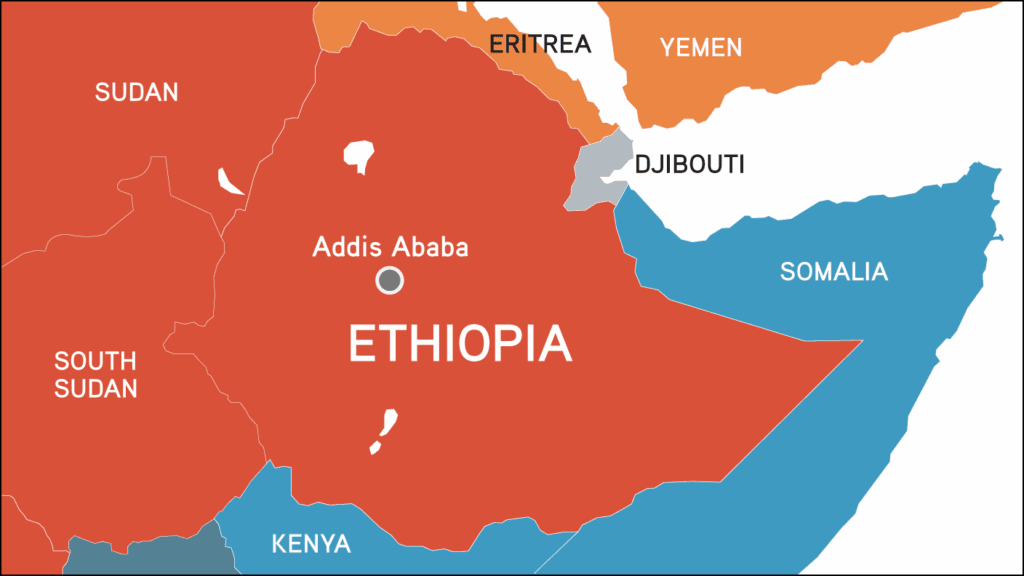
Populations across Ethiopia continue to be at risk of possible war crimes and crimes against humanity due to clashes between armed groups and government forces, as well as inter-communal violence. Escalating regional tensions also pose a threat.
Long-standing grievances and recurrent human rights abuses by government forces and armed groups in Ethiopia have caused multiple conflicts to flare since 2019. Hundreds of thousands of civilians have been killed, particularly in the Amhara, Oromia and Tigray regions, and over 3.3 million people remain displaced. Inter-communal and inter-religious violence, as well as regional border disputes, also continue.
Since 2019 conflict between the Oromia regional security forces, the Ethiopian National Defense Forces (ENDF) and the Oromo Liberation Army (OLA) armed group has killed thousands of civilians. All parties to the conflict have perpetrated violations and abuses that may amount to war crimes and crimes against humanity. Despite a December 2024 peace agreement signed by the federal government and an OLA faction, government forces continue to commit enforced disappearances and attacks on civilians, including through air and drone strikes and extrajudicial executions of individuals perceived to support the OLA. The OLA, which seeks autonomy for ethnic Oromos, has also targeted ethnic Amharas living in Oromia and border areas.
From November 2020 to 2022, the ENDF and its allies, including the Eritrean Defense Forces (EDF), fought the Tigray Defense Forces (TDF). The hostilities, which initially began in Tigray, later spread to the neighboring Afar and Amhara regions. All parties to the conflict committed war crimes and/or crimes against humanity, with the Tigrayan population enduring the highest levels of violence. These abuses included mass sexual violence perpetrated by armed groups. Several UN bodies, including the International Commission of Human Rights Experts on Ethiopia (ICHREE), and rights groups documented indiscriminate bombings, ethnic killings, forced displacement and the destruction of cultural heritage and vital infrastructure. Amnesty International and Human Rights Watch also reported that Eritrean and Amhara forces, with ENDF complicity, carried out the ethnic cleansing of Tigrayans in Western Tigray.
Although the federal government and the regional governing body, the Tigray People’s Liberation Front (TPLF), signed a cessation of hostilities agreement (CoHA) on 2 November 2022, abuses by the EDF and Fano, an ethnic Amhara militia, have continued in Tigray, including sexual violence and extrajudicial killings of civilians. The regional administration estimates that around 40 percent of Tigray remains occupied, including by the EDF and Amhara forces in the west. Meanwhile, internal factionalism in the TPLF has heightened tensions following the CoHA. In 2024 the TPLF fractured, mainly between a faction loyal to longtime chairman Debretsion Gebremichael (TPLF-D) and another aligned with former deputy Getachew Reda. The split is further complicated by Eritrea’s involvement and the TPLF-D’s alleged ties to the Eritrean government.
In the Amhara region, the ENDF and Fano forces have engaged in clashes in and around civilian areas since April 2023. Throughout the conflict, the UN and other international human rights monitors have documented widespread reports of extrajudicial killings, arbitrary detentions, forced displacement, destruction of property, attacks on healthcare, looting and widespread cases of sexual violence, including rape. According to these reports, federal government forces are responsible for most abuses.
While national accountability efforts have been minimal, other justice initiatives have progressed. In May 2025 the African Commission on Human and Peoples’ Rights heard a case brought by Legal Action Worldwide (LAW) and its partners, accusing the Ethiopian government of ongoing violations in Tigray. LAW also filed a universal jurisdiction complaint in Germany against Ethiopian and Eritrean officials for war crimes and crimes against humanity. Separately, Amnesty International is leading a $2 billion reparations case before a Kenyan court against Meta for failing to remove hate speech that incited killings.
Throughout 2025 Ethiopian authorities escalated repression of independent civil society and the media. This included suspending and closing prominent rights organizations, proposing legal reforms that would sharply increase government control over their operations and using vague charges to target critics. The government also amended the media law to centralize regulatory power under the executive branch, suspended foreign media personnel and has continued to arbitrarily detain journalists, contributing to widespread self-censorship. Rights groups also documented shrinking civic space ahead of the June 2026 elections, including harassment of journalists, activists and civil society organizations.
Tensions have escalated since the TPLF-D announced on 5 May the restoration of the pre-war Tigray State Council and appointment of Debretsion Gebremichael as regional president, directly challenging the federally backed interim administration. The move followed accusations that the federal government was undermining the CoHA by withholding civil servants’ salaries, restricting fuel and aid delivery and extending the interim administration’s mandate. Renewed troop mobilization along Tigray’s borders and skirmishes between the TDF and federal-aligned forces have further fueled fears of a broader regional confrontation involving Eritrea. Reports have emerged of authorities in Tigray forcibly recruiting civilians, including children as young as 15, through abductions and coercive conscription since April 2026, creating a climate of fear.
Meanwhile, identity-based persecution and grave human rights abuses continue across multiple regions. Human Rights Watch has documented ongoing arbitrary detention, discrimination and movement restrictions targeting Tigrayan civilians, reflecting patterns that fueled previous atrocity crimes. Civilians and places of worship have also been targeted in East Arsi Zone of Oromia, where armed men targeted civilians, killing at least 13 and burning a church to the ground.
The humanitarian situation has also deteriorated amid fuel shortages and aid cuts that are severely disrupting operations across the country, with worsening conditions in camps and reduced access to food, healthcare and protection services.
Targeted attacks by ethnic militias, as well as the federal government’s retaliation against communities, increases the risk of identity-based violence and abuses, particularly for Amharas in Oromia and Oromos in Amhara. Identity-based killings and targeted attacks on civilians and civilian infrastructure violate International Humanitarian Law (IHL) and International Human Rights Law (IHRL) and may amount to crimes against humanity and war crimes.
Populations in Tigray, Afar and Amhara also remain at risk of war crimes and crimes against humanity amid violations of the CoHA. Disputes over western Tigray and other territories heighten risks of conflict between Amhara and Tigrayan groups. The continued presence of the EDF, combined with the TPLF’s internal divisions and other external factors that have exacerbated tensions, including Eritrea’s reported support for the TPLF-D, has heightened fears of renewed conflict between TPLF factions and the federal government, as well as a broader confrontation between Eritrea and Ethiopia.
A history of impunity and lack of effective transitional justice for abuses perpetrated under successive ruling parties has exacerbated grievances. ICHREE, the only international body monitoring the situation in Ethiopia was terminated in October 2023 despite issuing warnings of ongoing and future atrocity risks. Victims and survivors of the recent violence called for the country’s Transitional Justice Policy to include international elements; however, these calls were not heeded, reducing trust in the domestic accountability process.
Government forces must comply with international law, prioritize civilian protection and transparently investigate alleged abuses to ensure accountability and restore trust with victims and affected populations. Armed groups must end the targeting of civilians. The EDF should immediately withdraw from Ethiopia. The federal government, regional authorities in Tigray and Eritrean authorities must de-escalate tensions to prevent renewed conflict.
Sustained, coordinated diplomatic pressure is needed to ensure full implementation of the CoHA, including clear benchmarks, public reporting and consequences for non-compliance. The African Union and key states involved in brokering the agreement should push for its implementation.
UN member states should ensure engagement at the Security Council and Human Rights Council, calling for independent human rights monitoring and strengthened accountability efforts, including international investigative and evidence-preservation mechanisms. Due to the lack of confidence in domestic accountability measures, the international community should also explore alternative options, including through universal jurisdiction. It is imperative for all parties to pursue conflict resolution tracks before implementing transitional justice initiatives to allow for a holistic, inclusive and long-lasting process. The federal government should work with UN Special Procedures and other experts on transitional justice to ensure processes meet international standards.
For more on the Global Centre’s advocacy work on the situation in Ethiopia, see our Ethiopia country advocacy page.
Ralph Bunche Institute for International Studies
The Graduate Center, CUNY
365 Fifth Avenue, Suite 5203
New York, NY 10016-4309, USA