25 February 2026
Atrocity Alert
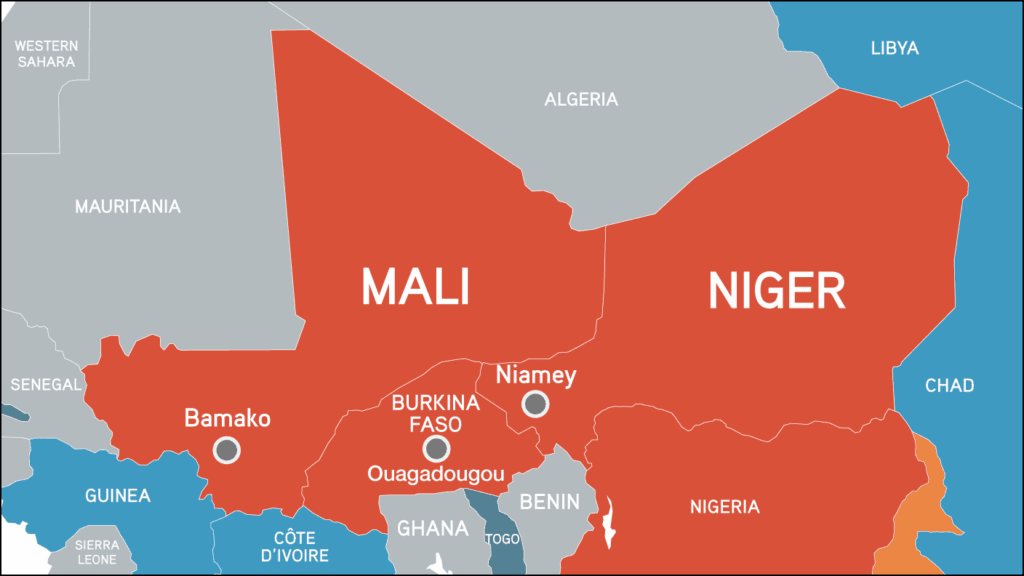
Recurrent and expanding violence perpetrated by armed Islamist groups, as well as security operations to confront them, threaten populations in the Central Sahel – Burkina Faso, Mali and Niger – with violations that likely amount to crimes against humanity and war crimes.
Populations in the Central Sahel – Burkina Faso, Mali and Niger – are enduring armed conflict and inter-communal violence amidst an entrenched insurgency driven by armed Islamist groups affiliated with al-Qaeda (JNIM) and the so-called Islamic State Sahel Province (ISSP). Violence has also taken place between rival ethnic militias and community-based self-defense groups resulting in reprisal attacks and countless abuses.
Armed Islamist groups perpetrate recurrent abuses and attacks against civilians. These groups systematically use sieges, threats, kidnappings, improvised explosive devices (IEDs), drones and landmines as deliberate tactics of war as they seek to control supply routes and increase areas of influence. They have also enforced their own interpretation of Sharia law in areas under their control, imposing severe gender discriminatory rules. In besieged areas, armed Islamist groups are blocking humanitarian aid to civilians and causing starvation, imposing forced taxation and strategically destroying and looting civilian objects, including places of worship, health centers, food reserves and water services, among other violations of International Humanitarian Law (IHL). Insurgents also routinely perpetrate grave violations against children and target secular state education, burning schools and threatening, abducting or killing teachers.
Counterterrorism operations have often led to human rights violations in all three states, with security forces in Mali and Burkina Faso implicated in likely war crimes and crimes against humanity. The Malian Armed Forces (FAMa) and Russian state-controlled Africa Corps (formerly the Wagner Group) have perpetrated possible war crimes and crimes against humanity, including summary executions, indiscriminate airstrikes, rape and sexual violence, pillaging and torture against civilians, among other abuses. State-sponsored militias in Burkina Faso, notably the Volunteers for the Defense of the Homeland (VDP), have also been implicated in grave crimes along ethnic lines.
The insurgency in the Central Sahel has its origins in the 2012-2013 armed conflict in northern Mali, during which numerous parties to the conflict, including Tuareg separatists and a coalition of armed Islamist groups, perpetrated atrocity crimes. The International Criminal Court (ICC) subsequently issued an arrest warrant for Iyad Ag Ghaly, the head of the armed Islamist group Ansar Dine, for war crimes and crimes against humanity. The ICC has convicted Al Hassan Ag Abdoul Aziz, a senior member of the Islamic Police of Timbuktu and Ansar Dine, of war crimes and crimes against humanity, while Ahmad al-Faqi al-Mahdi was convicted of war crimes for the intentional destruction of cultural sites. Accountability remains limited with few alleged perpetrators having been arrested, prosecuted or tried for international crimes.
The region has faced significant political and security upheaval since 2020, including military takeovers in all three countries. These regimes have imposed several measures to repress civic and political space and reduce international scrutiny into the country’s human rights situations. Journalists, human rights defenders, political opposition and others have faced arbitrary detention, enforced disappearances and unlawful forced military conscription. The three military regimes created the Alliance of Sahel States (AES) in 2023 and formally withdrew from the Economic Community of West African States in January 2025 and launched the AES Unified Force – a joint security mechanism – in December. In September 2025 the African Union Peace and Security Council established a “Task Force” to support Sahelian countries in countering terrorism and addressing broader security, socio-economic and humanitarian challenges.
The security and protection situation across the Central Sahel continues to deteriorate sharply. The UN Office for the Coordination of Humanitarian Affairs (OCHA) recorded 2,976 security incidents resulting in 7,900 deaths in the region between January and August 2025. Armed Islamist groups have expanded control along major roads, destabilizing markets and isolating entire communities, including increasingly in urban areas. During February 2026 JNIM launched a week-long series of coordinated attacks across eastern and northern Burkina Faso, underscoring the group’s growing operational reach and mobility across large swathes of territory.
In late January 2026 the Burkinabè government announced measures to dissolve all political parties. The Office of the UN High Commissioner for Human Rights (OHCHR) continues to receive allegations of enforced disappearances and arbitrary arrests in Burkina Faso. The New Humanitarian reported that arrests of aid workers have increased in recent months, targeting national and international staff, while new policies introduced in 2025 restrict humanitarian organization’s ability to operate effectively.
Southwest Niger’s Tillabéri region continues to face recurrent attacks by armed groups. According to ACLED, Tillabéri became the deadliest region across the Central Sahel in 2025, with the highest level of civilian targeting, primarily by ISSP, followed by the Nigerien military then JNIM. Suspected militants killed over 50 civilians across two major attacks in early 2026. Amid the spike in insurgent activity, the Nigerien military has stepped up counterinsurgency operations and, in December, declared a “general mobilization,” granting sweeping powers to requisition civilians and resources to reinforce operations. Drone strikes have killed scores of civilians, likely amounting to war crimes. In February ISSP militants launched an unprecedented, high-profile attack on the international airport in the capital.
In Mali, violence has recently spread to the southwest, while populations in Timbuktu, Gao, Mopti and Ménaka continue to face recurrent attacks, abductions and the forced collection of zakat. In December OCHA reported a sharp increase in humanitarian access constraints linked to the presence of IEDs, up 155 percent from November, particularly in Ségou, Sikasso and Timbuktu, alongside a doubling of incidents of violence against humanitarian workers. OHCHR documented hundreds of extrajudicial executions, arbitrary arrests and detentions and enforced disappearances by all parties in 2025 and UN experts asserted that the enforced disappearances may constitute crimes against humanity. Malian refugees in Mauritania have shared with aid workers and news sources accounts of abuses by Africa Corps, including indiscriminate killings, abductions, sexual violence and torture.
Meanwhile, in February 2026 former Malian prime minister Moussa Mara was sentenced to two years in prison for “discrediting the state,” among other charges, due to a social media post expressing solidarity with detained political and civil society figures. The sentencing reflects the weaponization of the justice system to target political figures who question the junta’s governance and security strategies. That month, a group of UN Special Procedures issued a statement on ongoing enforced disappearances in Mali, warning that the frequency, organized nature and methods used suggest a systematic nature.
While Burkina Faso, Mali and Niger each face distinct challenges, these states also share a legacy of structural vulnerabilities, weak governance, limited state presence and porous borders. Although the military authorities in each country have expressed a goal of advancing security to protect civilian lives, the security situation has continued to deteriorate and state authority weakened. While the FAMa has a record of human rights violations, the scale of crimes has increased since the deployment of Russian paramilitaries.
The expanded area of control by armed Islamist groups has resulted in serious human rights abuses and war crimes. Armed Islamist groups appear to be deliberately targeting civilians as a tactic to pressure communities into cooperation, as well as utilizing blockades to punish communities perceived to be supportive of the military. These groups are increasing community outreach and preaching efforts to present themselves as “protectors” in attempts to consolidate their influence. They are also deliberately disrupting economies, including through coordinated offensives blocking key trade and transport routes, to undermine government authority; however, these blockades are significantly worsening humanitarian conditions.
Populations continue to be targeted and persecuted on the basis of their ethnic and/or religious identity. The VDP’s actions fuel abuses and possible atrocity crimes, aggravate ethnic tensions, encourage militant recruitment among pastoralists and contribute to prevailing impunity. The growing use of air and drone strikes, IEDs and rocket and mortar shellings underscores a shift in combat tactics by JNIM and ISSP, contributing to indiscriminate violence, civilian harm and likely war crimes.
The crackdown against human rights defenders and civic space across the three countries has inhibited independent documentation and monitoring of violations and abuses. Other efforts to investigate allegations of atrocities by state actors have also been undermined. The announced withdrawal from the ICC further weakens avenues for justice and redress for victims of atrocity crimes.
While countering violent extremism remains crucial, it is essential that all armed actors ensure that their operations comply with IHL, as well as the Principles and Guidelines on Human and Peoples’ Rights while Countering Terrorism in Africa, and do not exacerbate inter-communal tensions or fuel further violence. The militaries must establish guidelines on the use of aerial weapons during operations and ensure they minimize civilian harm. All actors should refrain from supporting or collaborating with ethnically aligned militias with poor human rights records. The African Union should call for an extraordinary session to address the crisis across the region, as well as publicly denounce abuses.
Additional measures must be implemented to end the proliferation of arms, improve land management and reach political settlements in areas where atrocity risks are greatest.
The military authorities of the Central Sahel – with support from national human rights commissions and the African Commission on Human and Peoples’ Rights – should investigate all violations of International Human Rights Law and IHL. Authorities must stop threatening civil society, ensure they can operate without fear of reprisals and release all those arbitrarily detained. The Malian military government should cooperate with the UN Independent Expert on the situation of human rights in Mali to ensure they can effectively carry out their mandate.
For more on the Global Centre’s advocacy work on the situation in the Central Sahel, see our Central Sahel country advocacy page.
Ralph Bunche Institute for International Studies
The Graduate Center, CUNY
365 Fifth Avenue, Suite 5203
New York, NY 10016-4309, USA